
September is when the bill comes due for August. Three months of extra laundry, houseguests, pool splash-out, backyard cooking, and grease going down the kitchen sink leave a residue in your drain lines that does not clear itself. Then the first real rain arrives, groundwater rises, and a partially blocked lateral that was coping fine finally stops coping. That is the pattern we see across older La Habra, Whittier, and San Gabriel Valley neighborhoods: a drain that was "a little slow" in July becomes a backed-up shower and a wet hallway in November.
The cost difference matters. Clearing a main line before it backs up typically runs $200 to $600. Cleaning up after a sewage backup into finished flooring routinely runs into the thousands before anyone touches the pipe.
Run this five-item checklist before the rains
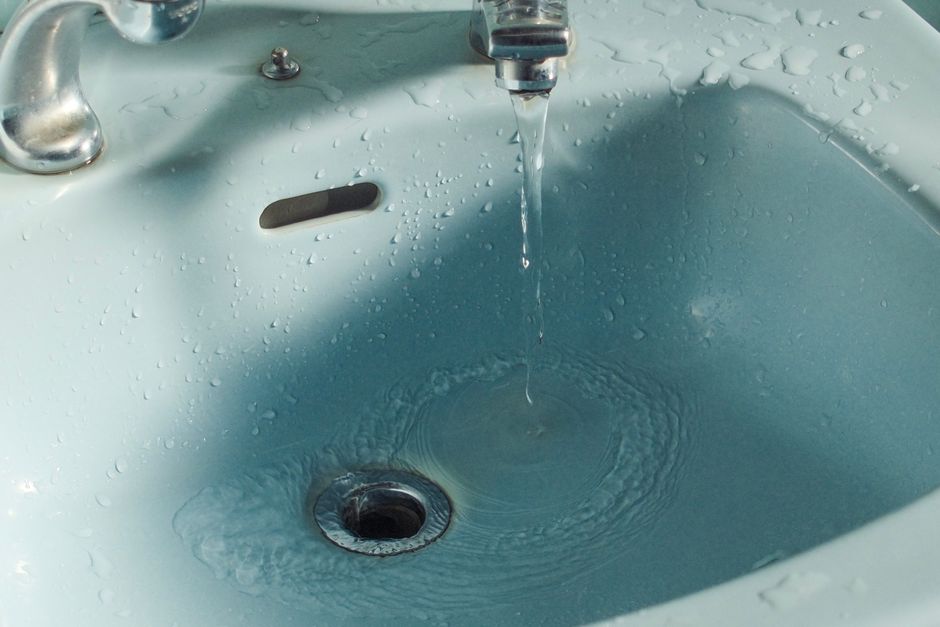
- Time your fixtures. Fill a bathroom sink and pull the stopper. A healthy sink drains in roughly 10 to 15 seconds. A tub should clear standing water in under a minute. If one fixture is slow and the rest are fine, the problem is local — the P-trap or the branch line. If several fixtures are slow at once, especially the lowest ones in the house, suspect the main sewer line. That distinction is the single most useful thing you can learn in ten minutes. DIY.
- Pull and clean the pop-up stoppers and P-traps under bathroom sinks. Hair and soap scum collect at the stopper pivot rod and just past the trap bend. A bucket, channel-lock pliers, and fifteen minutes usually restores full flow. Skip the caustic drain crystals; in older galvanized branch lines they sit against the pipe wall and accelerate corrosion, and they make the line dangerous for whoever opens it next. DIY, with the caveat that if the slip nuts are corroded shut, stop and call someone.
- Locate your cleanout. Most homes here have a capped cleanout in the side yard or near the front foundation, often a 3- or 4-inch ABS or cast-iron stub. Some older San Gabriel Valley houses have it buried under decades of added landscaping or a concrete patio pour. Find it now, clear the plants off it, and mark it. If a pro has to hunt for or excavate a cleanout during a backup, the visit gets longer and more expensive. Finding it is DIY; opening it under pressure is not — a capped cleanout can be holding back a full line of sewage.
- Check the kitchen line specifically. Summer cooking pushes fats and oils into the drain warm; they cool and congeal into a ring inside the pipe, narrowing it over months. Gurgling at the sink or a disposal that drains fine empty but backs up under load points to a grease-restricted 2-inch line. Snaking may punch a hole through it. Hydro jetting actually scours the wall back to full diameter, which is why it typically costs $350 to $800 versus $150 to $350 for a cable. Pro.
- Listen and smell. Toilets that bubble when the washing machine drains, a faint sewer odor in a bathroom that gets little use, or a lawn patch that stays green and soft in the middle of a dry October are all main-line signals. The dry-trap odor is the easy one: run water in the unused shower or floor drain for 30 seconds to refill the trap seal. If the smell persists, it is not the trap. DIY to test, pro to diagnose.
Why local conditions make this worse than it sounds
Housing stock is the first factor. A large share of homes in North Orange County and the San Gabriel Valley were built between the 1920s and the 1960s, which means cast-iron drain lines and galvanized supply piping. Cast iron has a practical service life of about 50 to 75 years; past that, the interior scales, tuberculates, and eventually channels along the bottom. A line like that does not need much summer grease to start failing.
The second factor is trees and clay soil. Mature ficus, liquidambar, and Chinese elm roots follow moisture, and they find hairline cracks and joint gaps in old clay or cast-iron laterals. Soil here shrinks through the dry season and swells with the first sustained rain, which shifts pipe joints and opens those gaps further. That is why root intrusions announce themselves in October and November far more often than in June.
Hard water compounds it. Most of this region runs well above 10 grains per gallon, and that mineral load builds scale inside fixtures and the water heater tank. It will not clog a drain by itself, but it means your tank heater is likely at the short end of the 8 to 12 year range, and the anode rod sacrificed itself years earlier than the brochure suggested.
What can wait, and what cannot
A single slow bathroom sink can wait a week or two. A slow tub with a working toilet can wait a few days. What cannot wait: any water at the lowest drain in the house when another fixture runs, sewage at a floor drain or shower pan, or a toilet that rises and holds. Those mean the main line is restricted, and every gallon the household uses has to go somewhere. Shut off water use to the affected side of the house and get a camera in the line that day.
Also do not wait on visible water around a wall base or a cabinet floor that stays damp. Hidden leaks in slab-foundation homes — common throughout this area — show up as a warm spot on the floor, an unexplained jump in the water bill, or the sound of running water with every fixture off.
Where to spend and where not to
A camera inspection of the main line typically runs $200 to $500, and many companies credit it toward a repair. It is worth it before you authorize any digging, because it tells you whether you are looking at a root ball at one joint or a collapsed section. Spot repairs of a lateral typically run $1,500 to $4,000. Full replacement runs $4,000 to $15,000 and climbs when the line crosses a driveway, runs under a slab, requires a city permit and street-cut restoration, or is deep enough to need shoring. Trenchless pipe lining often lands in the same range but avoids the hardscape demolition.
Anything behind a wall, under a slab, involving gas, or requiring a permit belongs with a licensed plumber. Water heater replacement is the common surprise here: the swap itself is routine, but permits are typically required, and code may add a seismic strapping upgrade, an expansion tank, a drain pan with a routed discharge line, or a new T&P relief line. Those additions commonly push a $1,500 job toward $2,500.
If you do only one thing
Find your main cleanout and take the cap off the shrubbery, not the pipe. Knowing exactly where it is turns a chaotic emergency call into a 45-minute job, and it is free.